The MOJO Advantage — Whitepaper
June 16, 2026 · By Metify

How Intelligent Automation, Hardware Versatility, and Operational Simplicity Are Redefining Enterprise Bare Metal
A Metify Whitepaper · June 2026
Executive Summary
The post-VMware era has put thousands of enterprises in front of a once-a-decade architectural decision. The wrong answer is to pick a different hypervisor and call it done. The right answer is to recognize that the operational layer for bare metal needs to be rebuilt for an era where AI agents can reason about infrastructure, Kubernetes is the new universal scheduler, and the hardware fleet itself is multi-vendor, multi-site, and increasingly air-gapped.
MOJO is the platform built for that moment. This paper makes the case along five dimensions:
- Power — specialist AI agents that observe, reason, and act on bare metal, governed by approval gates and audit trails
- Versatility — multi-vendor, multi-OS, multi-site, air-gap-first, with native DDI and Redfish normalization across Dell, HPE, Lenovo, Supermicro, Cisco, Intel, and NVIDIA
- System of Record — the canonical source of truth for what hardware exists, what state it’s in, and who changed what, across data centers, retail stores, healthcare facilities, banks, and cell-site shelters
- Ease of Use — natural-language operations, single-binary deployment, and a unified inventory that replaces five separate vendor tools
- Intelligent Automation — orchestration that decomposes intent into multi-step execution plans, validated and committed only with governance
The paper closes with three customer scenarios — financial services, distributed retail, and broadcast media — that illustrate what AI-native infrastructure operations actually look like in production.
1. The Infrastructure Inflection Point
For two decades, enterprise infrastructure operations were organized around a stable set of assumptions: a primary hypervisor vendor would provide the operational layer, vendor-specific tools would manage hardware fleets, and human operators would translate business intent into infrastructure changes through dashboards, CLIs, and tribal knowledge. All three of those assumptions are breaking at once.
The Hypervisor Assumption Is Breaking
Broadcom’s acquisition of VMware reset the economics of virtualization. Documented price increases of 150% to over 1,200% have prompted the largest infrastructure re-evaluation in a decade. Court filings in the AT&T v. Broadcom case revealed a proposed 1,050% one-year price increase for the carrier’s 75,000-VM environment, alongside AT&T’s $40–50 million migration budget calculation with what the company described as “a very quick payback.” Computershare publicly committed to migrating 24,000 VMs to Nutanix after receiving renewal terms representing a 10–15× increase. By April 2026, Nutanix CEO Rajiv Ramaswami publicly stated that approximately 30,000 customers had migrated from VMware to Nutanix alone. Pure Storage research indicates that 60% of enterprises are actively accelerating virtualization modernization strategies through 2028. The customers leaving aren’t picking a single replacement. They’re splitting across Nutanix AHV, Proxmox VE, Microsoft Azure Stack HCI, Red Hat OpenShift Virtualization (KubeVirt), and several other alternatives — chosen on different axes for different workloads. The era of one operational layer for one virtualization vendor is over.
The Single-Vendor Tooling Assumption Is Breaking
Enterprise hardware fleets were never single-vendor in reality, but vendor tooling pretended otherwise. Each vendor ships its own management platform — one per manufacturer, each producing its own inventory, its own audit log, its own compliance dashboard. Each one excellent in its lane, each one blind to the other vendors in the rack. For organizations running 1,000 servers across three vendors, this means three monitoring stacks, three compliance models, three audit trails, and a custom integration layer holding them together. The integration layer is invariably understaffed, brittle, and the single biggest source of compliance gaps in the environment.
The Human-as-Operational-Layer Assumption Is Breaking
The third assumption is the quietest and the most consequential. Traditional infrastructure operations assume that humans translate business intent into infrastructure actions: a senior operator reads a ticket, opens five tools, makes a series of changes, validates the result, and updates the audit log. The cognitive load of this work scales linearly with fleet size. The cost of staffing it scales faster. The mean-time-to-recovery when the senior operator is on vacation scales worst of all. Modern AI architectures — specifically the ReAct (Reason + Act) pattern for structured tool-use, together with reliable governance frameworks — make a different operational model possible. Not autonomous AI doing whatever it wants. AI agents that observe, reason, and propose action, with humans retaining final authority through approval gates and audit trails.⚠️ THE INFLECTION POINT IN ONE SENTENCE
The hypervisor stack you trusted is being repriced out of viability, the multi-vendor reality your hardware lives in has no unified operations story, and the AI capabilities required to close those gaps have finally become reliable enough to deploy in production. The window to act is now.
2. The MOJO Architecture
MOJO was designed from a clean sheet for this moment. Three architectural layers, each chosen for a specific operational property.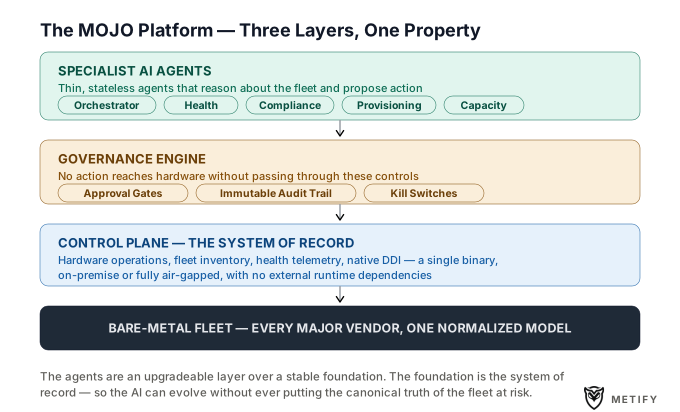
Layer 1: The Control Plane
The foundation is a purpose-built control plane that compiles to a single binary with no external runtime dependencies. This isn’t a stylistic choice. Deterministic, memory-safe control of hardware operations matters when you’re flashing firmware on thousands of servers simultaneously and a runtime pause at the wrong moment can mean a bricked node. The control plane handles hardware communication (Redfish, IPMI, vPro), event ingestion, the inventory database, native DHCP/DNS/IPAM, PXE boot orchestration, and the governed interface through which the agent layer operates on hardware. Single-binary deployment means `docker compose up` is the complete installation procedure — including in air-gapped environments where there is no internet for an installer to phone home to.
Layer 2: The Governance Engine
Every action that an AI agent proposes — every operation that would change hardware state — passes through the governance engine. The engine evaluates each action against three controls: an approval gate (some actions are auto-approved for read-only operations; others require human sign-off; the most destructive require multi-person approval), an immutable audit trail (every action and its approver are logged before execution), and a kill switch (every agent can be paused or stopped at the governance layer, not at the agent layer where a misbehaving agent might ignore it). This layer exists because “AI for infrastructure” is only viable if the AI is operating under controls that an enterprise audit team will sign off on. MOJO’s governance engine is designed to produce evidence — auditable, exportable, machine-readable evidence — that every infrastructure change was authorized by a named human, executed against a known policy, and logged before it happened.
Layer 3: The Specialist Agent Layer
The agents are thin by design. They do not hold state. They reason about live data pulled from the control plane, propose actions, and rely on the governance engine to actually commit anything. There are five specialists:
| Agent | Reasoning Pattern | Primary Outputs |
|---|---|---|
| Orchestrator | Natural-language intent → multi-step execution plan | Sequenced and parallelized work orders for other agents |
| Health | ReAct loop on sensor telemetry vs. learned baselines | Anomaly classification, severity assessment, remediation proposals |
| Compliance | Baseline evaluation across fleet | Drift reports, staged remediation plans, evidence packages |
| Provisioning | Lifecycle state machine for new and refreshed nodes | Discovery, allocation, OS install, validation |
| Capacity | Trend analysis on utilization and demand signals | Capacity forecasts, expansion recommendations |
The reason the agents are thin and the control plane is the source of truth is operational: if an agent goes off the rails, you can stop it, rebuild it, retrain it, replace it — without losing the underlying inventory or the audit history. The agents are an upgradeable layer over a stable foundation, not the foundation itself.
3. Power — What MOJO Can Actually Do
The first measure of an infrastructure platform is what it can do that nothing else can. MOJO’s distinguishing capabilities cluster around four areas.
Predictive Health on Learned Baselines
Traditional hardware monitoring fires alerts when sensor values cross fixed thresholds — “inlet temperature exceeded 35°C.” This produces three failure modes simultaneously: false positives during normal workload spikes, false negatives during slow drift toward failure, and alert fatigue that erodes operator attention. MOJO’s health agent operates differently. It builds rolling baselines for every metric on every node using Exponentially Weighted Moving Averages (EWMA), then applies Z-score analysis to detect statistical deviations from those baselines. The system learns what “normal” looks like for your specific environment — your specific server-37-in-rack-12 — and flags deviations against that local norm rather than a universal threshold.📈 WHAT LEARNED BASELINES CATCH THAT THRESHOLDS MISS
A node that normally runs at 28°C inlet temperature begins trending toward 32°C over a week. No static threshold fires — 32°C is well below any alarm setting. But the Z-score against this node’s learned baseline is 4σ, and the trend is monotonic. The health agent flags it before the workload-induced overheating event that would have followed.
The cause turned out to be a blocked airflow path from a cabling change three racks over. The fix took five minutes. Caught after the fact, it would have caused thermal throttling on the node and on the seven nodes downwind of it.The health agent also operates on a three-tier decision framework. Tier 1 actions (read-only observations, data collection, ticket creation) are auto-approved. Tier 2 actions (recommended remediations that an operator reviews and approves) are proposed but not executed without sign-off. Tier 3 actions (destructive operations like firmware updates, OS reinstalls, power cycling) require explicit human approval, often from a named approver group.
Cross-Vendor Firmware Compliance
The most underestimated source of risk in a mixed-vendor fleet is firmware drift — BIOS and BMC versions that diverge silently over time, sometimes containing CVEs, sometimes incompatible with each other, almost always undocumented in the spreadsheet that nobody updated. MOJO’s compliance agent maintains firmware baselines that span vendors. You define a policy once — “Baseline Gold-2026 requires iDRAC 7.10.50.00 or higher on Dell, iLO 5 3.05 or higher on HPE, XCC 6.20 or higher on Lenovo” — and the agent continuously evaluates the entire fleet against it. When drift is detected, the agent generates a remediation plan: identify the non-compliant nodes, sequence the updates to maintain capacity, stage the firmware payloads using Redfish 2025.2 bulk staging where supported, route the plan through governance for approval, execute the staged rollout, and validate post-update compliance. All five steps can be triggered by a single natural-language instruction to the orchestrator agent.
Out-of-Band Recovery
The reason VMware customers became dependent on remote management was that physical access to data centers became expensive, slow, and increasingly impractical (especially for distributed edge sites). MOJO restores and extends that capability without VMware in the path. Every node MOJO manages is reachable through its BMC over Redfish — Dell iDRAC, HPE iLO, Lenovo XCC, Supermicro IPMI — with vendor differences normalized into a consistent API. The platform provides KVM and serial console integration. It can power-cycle nodes, modify boot order, mount remote ISO images, roll back BIOS settings, and reinstall the OS remotely. The health agent can initiate Tier 3 recovery actions subject to governance. In the post-CrowdStrike data center conversation, this is the capability that lets a single operator recover a fleet of compromised or misconfigured servers from anywhere with network access to the management plane.
Multi-Site Federation
For organizations running infrastructure across distributed sites — edge retail locations, regional broadcast facilities, hospital networks, government installations — the MOJO Global Controller (MGC) federates multiple Edge Controllers into a single fleet view. Centralized policy, distributed execution, site autonomy when WAN links fail, automatic state reconciliation on reconnect. The compliance agent operates at the federation level: a firmware baseline policy can be evaluated across 50 sites, with site-specific remediation plans generated for each. The orchestrator agent can decompose “update firmware baseline across all West Coast sites” into 50 parallel site-level execution plans, each with its own governance flow. No vendor-specific tool or open-source provisioning engine federates multi-site bare metal as a first-class architectural property.
4. Versatility — Where MOJO Runs
The second measure is breadth: how many of the customer’s actual problems the platform addresses without forcing them to assemble a parallel toolchain for the gaps.
Vendor Coverage
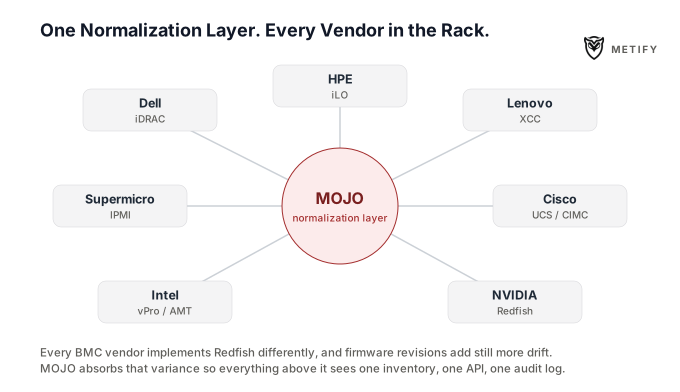 MOJO presents one inventory, one API, one audit log across Dell, HPE, Lenovo, Supermicro, Cisco, Intel, and NVIDIA hardware — including NVIDIA’s Redfish extensions for AI servers. MOJO’s Redfish drivers normalize vendor dialects (every BMC vendor implements Redfish slightly differently; firmware revisions within a single vendor introduce additional drift). This normalization is the single most-asked-for capability in customer engagements and the one that competitors with single-vendor heritage cannot reasonably retrofit.
Operating System Coverage
MOJO provisions and operates against RHEL, Rocky, AlmaLinux, Ubuntu, SLES, Windows Server, ESXi (during transition periods), and any modern OS reachable via PXE/iPXE/HTTP boot. The platform’s air-gap bundle support extends to OS images prepared offline and transported into isolated environments.
Deployment Models
The deployment story is deliberately flexible:
- On-premise — the default deployment, with the full platform running in a customer data center.
- Air-gapped — single-binary control plane, native DDI, self-hosted LLM support for Agent-M in fully disconnected environments. Defense, government, regulated finance, and critical-infrastructure deployments use this path.
- Multi-site federated — MOJO Global Controller with central policy and edge autonomy.
- Cloud-adjacent — for organizations running hybrid models, MOJO can manage on-prem bare metal while integrating with cloud-hosted services through the API.
Coexistence with the Workload Layer
MOJO does not compete with the layer above it. KubeVirt and OpenShift Virtualization can run on bare metal provisioned and managed by MOJO. RHEL, Rocky, and other Linux workloads land on MOJO-provisioned hosts. Ansible Automation Platform configurations land on the OS once it’s there. Kubernetes clusters — vanilla, OpenShift, EKS Anywhere, Rancher — install onto bare metal MOJO has prepared. This is the design property that distinguishes MOJO from platform-replacement tools. The objective is to give the workload layer a clean, consistent, observable, healthy substrate — not to subsume it.
5. MOJO as the System of Record
The cumulative effect of versatility is something larger than the sum of the deployment shapes. Over the last year, MOJO has crossed a threshold that very few infrastructure platforms ever reach: for our customers, it has become the system of record for what is actually running on the physical infrastructure. This is not a marketing claim. It is a description of what the platform now does in production.
What “System of Record” Actually Means
A system of record is the canonical, authoritative source for a class of data. For most enterprises, the answer to “what hardware do we have, where is it, what state is it in, and who changed it last?” used to live in several incomplete places: a CMDB that drifted from reality the moment it was published, three vendor consoles each blind to the other vendors in the rack, a monitoring stack that knew which IPs responded but nothing about firmware or BIOS, and a spreadsheet a former employee maintained. MOJO replaces that whole stack with a single canonical truth:
| Question | Where the Answer Lives Now |
|---|---|
| What hardware exists in our fleet? | MOJO inventory — make, model, serial, BMC reachability, location |
| What firmware revisions are running? | MOJO compliance agent — continuous evaluation against baselines |
| What state is each node in right now? | MOJO health agent — predictive baselines, anomaly detection, live telemetry |
| Who changed what, when, and with whose approval? | MOJO governance engine — immutable audit trail with named approvers |
| What was running on date X, before incident Y? | MOJO history — point-in-time queries against the canonical record |
| How does our fleet compare to itself? | MOJO drift analysis — baseline conformance, configuration variance, anomaly correlation |
Where MOJO Is the System of Record Today
The footprint cuts across industries and across the topology of modern infrastructure — from a few central data centers to thousands of distributed sites:🏢 Enterprise Data CentersMulti-OEM fleets at scale — Dell, HPE, Lenovo, Supermicro — running RHEL, OpenShift, KubeVirt, and traditional VM workloads. MOJO replaces three or four vendor consoles with one source of truth.🛒 Retail StoresDistributed bare metal at the store level for POS, inventory, and IoT aggregation. MGC federates hundreds or thousands of store sites into one canonical inventory and lifecycle history.🏥 Healthcare FacilitiesHospital and clinic hardware running clinical applications under HIPAA scope. MOJO provides the authoritative configuration and change records that HIPAA evidence requires.🏦 Banks & Financial ServicesRegulated environments under PCI DSS and SOX scope. MOJO gives auditors a single, defensible answer to “what was running, when, and with whose approval.”📡 Cell-Site SheltersTelecom edge compute at the base of every cell tower — BTS shelters where physical access is expensive and the central NOC needs canonical state for every site in the footprint.📺 Broadcast VenuesEvent-driven infrastructure deployed at stadiums and production venues. MOJO tracks every server through every event, with venue-by-venue state visible from headquarters.
Why This Matters More Than the Feature List
Becoming the system of record is not a checkbox capability. It is an emergent property that arises when a platform reliably absorbs the workload that used to be distributed across CMDBs, vendor consoles, spreadsheets, monitoring tools, and tribal knowledge. The threshold isn’t crossed when the feature ships. It’s crossed when customers stop maintaining the parallel records and start treating MOJO as the answer. That threshold has consequences:
- Auditors get a single answer. When the regulator asks the bank what BIOS was on a specific server on a specific date, the answer is one query against MOJO’s history — not a multi-week reconciliation.
- Integrations get a single feed. ITSM, GRC, SIEM, asset management — these systems can subscribe to MOJO as their ground truth for bare-metal state, instead of polling four vendor tools and reconciling the differences.
- Operators get a single mental model. The senior operator who used to be the human integration layer between three vendor consoles can now reason about the whole fleet through one interface.
- AI agents get a foundation they can trust. The orchestrator, health, compliance, and capacity agents reason against canonical data — which is why their proposed actions are good enough to put through governance and execute.
This last point is the connection back to the rest of the platform. The agents are valuable because they reason against ground truth. The ground truth exists because MOJO has become the system of record. The two properties reinforce each other, and neither would deliver the same value alone.
6. Ease of Use — The Operational Burden Comes Down
The fourth measure is operational. Power, versatility, and being the system of record are worth less than they sound if they require a six-month onboarding project and a team of platform engineers to run.
Natural-Language Operations
The orchestrator agent accepts intent expressed in plain English and decomposes it into executable plans. “Onboard rack 7 with the OpenShift baseline and RHEL 9” is sufficient input. The agent identifies the nodes in rack 7, allocates IP addresses from the appropriate subnet, creates DHCP reservations, generates DNS records, validates against the firmware baseline (escalating any drift through compliance), provisions the OS, and validates the result. Every destructive step routes through governance. Agent-M, the natural-language copilot interface, provides the same affordance for ad-hoc operator queries. “Show me all nodes with ECC errors above threshold in the last 24 hours.” “Which servers are non-compliant with baseline Gold-2026?” “What’s the thermal profile of rack 4 right now?” RBAC-aware, with 17+ tool functions exposed to the assistant. The operator does not learn a new query language. They ask the platform what they would otherwise ask a senior teammate.
Single-Binary Deployment
The complete MOJO platform installs in a single command. `docker compose up` brings up the control plane, the DDI services, the agent layer, the governance engine, and the management UI. There is no heavyweight runtime to tune, no Kubernetes cluster required for the platform itself (though MOJO can manage Kubernetes clusters running on its bare-metal substrate), no cloud account to configure, no phone-home telemetry by default. This matters most in the deployments where it’s least optional — air-gapped environments, FedRAMP-bounded environments, regulated finance environments — where every additional runtime dependency is a separate approval. One binary, one approval.
A Unified Inventory Replacing Five Tools
For a mixed-vendor fleet, the operational simplification is concrete. One inventory replaces three or four vendor-specific inventories. One API surface replaces three or four vendor APIs. One audit log replaces three or four audit logs. One compliance model replaces vendor-specific compliance dashboards. Vendor-specific management platforms commonly cite 28 person-hours saved per week. That figure typically applies to single-vendor environments. For mixed-vendor shops, the equivalent figure is multiplied by the number of OEM tools collapsed into a single MOJO interface. Most of MOJO’s customer engagements involve replacing three or more vendor tools.
7. Intelligent Automation — From Manual to Autonomous, Safely
The fifth and most consequential measure is automation: not the brittle script-driven kind, but the reasoning kind that handles the cases the scripts don’t anticipate.
The ReAct Loop in Production
Every MOJO agent runs the same fundamental pattern, drawn from current AI research and adapted for infrastructure operations: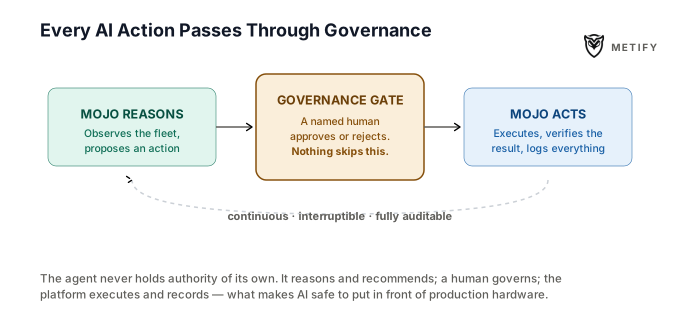 This loop is the operational pattern of every MOJO agent. The orchestrator runs it at the plan level. The health agent runs it on every detected anomaly. The compliance agent runs it on every drift detection. The provisioning agent runs it on every lifecycle transition.
The critical design property is that the loop is interruptible and auditable at every step. An operator can intervene at Propose. The governance engine can block at G. The validation step at V can trigger a rollback if the post-condition isn’t met. There is no point in the loop where an agent commits an action that a human cannot inspect, prevent, or reverse.
This loop is the operational pattern of every MOJO agent. The orchestrator runs it at the plan level. The health agent runs it on every detected anomaly. The compliance agent runs it on every drift detection. The provisioning agent runs it on every lifecycle transition.
The critical design property is that the loop is interruptible and auditable at every step. An operator can intervene at Propose. The governance engine can block at G. The validation step at V can trigger a rollback if the post-condition isn’t met. There is no point in the loop where an agent commits an action that a human cannot inspect, prevent, or reverse.
What Automation Actually Eliminates
The cumulative effect is a meaningful shift in what infrastructure operators spend their day doing. Before MOJO, a typical Day 2 operations team in a mid-sized enterprise spends most of its time on:
- Translating tickets into a sequence of vendor-specific tool actions.
- Manually reconciling state between systems.
- Running compliance scans and producing evidence reports for auditors.
- Triaging alerts to determine which ones are real.
- Coordinating remediation across vendor tool silos.
After MOJO, that same team spends most of its time on:
- Reviewing and approving agent-proposed actions.
- Defining and updating policies (firmware baselines, remediation thresholds, governance rules).
- Working on the strategic capacity, architecture, and modernization initiatives that were previously crowded out.
This is not a story about replacing operators with AI. It is a story about changing what operators do — from manual execution of repetitive work to oversight of automated reasoning. The capacity recovered is meaningful: most customer engagements deliver this shift within the first 90 days of deployment.
8. Customer Outcomes
The architecture and the capability claims would be theoretical without operational evidence. Three customer scenarios illustrate what MOJO actually delivers in production.
Scenario A — Financial Services, Multi-Vendor Fleet at Scale
A financial services customer manages over 10,000 servers across Dell, HPE, and Lenovo hardware. Before MOJO: three separate vendor management tools, a custom monitoring stack assembled from Prometheus and Grafana, manual firmware compliance processes run quarterly (and often missed), and a compliance audit process that consumed weeks of operations team time twice a year. After MOJO: one inventory across all three vendors. One firmware compliance model evaluated continuously against the defined baselines. One audit log with every action and approver recorded. The firmware compliance process moved from a quarterly manual exercise to a continuous automated evaluation with one-click remediation. The audit preparation time dropped from weeks to a single export from MOJO’s governance engine.✓ MEASURED OUTCOMES — FINANCIAL SERVICES
- Firmware compliance cycle time: quarterly manual project → continuous automated evaluation
- Audit evidence preparation: weeks of operator time → single governance-engine export
- Tools consolidated: 3 vendor management tools + custom monitoring stack → 1 unified platform
Scenario B — Distributed Retail Edge
A retail customer operates edge infrastructure across dozens of locations — servers in regional distribution centers, in-store back-of-house systems, and standalone fulfillment sites. Before MOJO: each site managed semi-independently, with periodic operator visits to apply firmware updates and resolve hardware issues. Truck rolls were expensive, slow, and increasingly impractical given the geographic spread. After MOJO: the MOJO Global Controller federates every site into a single fleet view. The health agent monitors every server at every location. The compliance agent ensures firmware baselines are consistent across the entire footprint. When something needs attention at a site 500 miles from the nearest operator, the orchestrator agent handles it remotely through out-of-band management — without a truck roll.✓ MEASURED OUTCOMES — DISTRIBUTED RETAIL
- Truck-roll-driven remediation events: substantial reduction
- Multi-site fleet view: per-site dashboards → single federated inventory
- Firmware consistency: site-by-site drift → continuous fleet-wide enforcement
Scenario C — Broadcast Media, Event-Driven Provisioning
A media and entertainment customer manages broadcast infrastructure for live events. The pattern is bursty: large numbers of servers must be provisioned in advance of an event, configured with event-specific OS images and baselines, and then turned around for the next event with a different configuration. Before MOJO: the provisioning process required a full day of operator time per rack, with manual coordination between provisioning, networking, and broadcast engineering teams. Mistakes were not catastrophic, but they were chronic. After MOJO: the orchestrator agent accepts natural-language instructions like “provision 20 servers with the broadcast baseline and event OS for the Tuesday production” and decomposes them into multi-step execution plans with dependency tracking, parallel execution, and governance approval. What used to take a full day of operator time now takes one sentence and one approval click.✓ MEASURED OUTCOMES — BROADCAST MEDIA
- Per-rack provisioning time: full day of operator work → single sentence + single approval
- Cross-team coordination: manual handoffs → orchestrator-managed parallel execution
- Configuration error rate: chronic → near zero (validation built into the agent loop)
9. Looking Forward
The platform’s roadmap is anchored on three trajectories. Deeper Red Hat ecosystem integration. As OpenShift Virtualization adoption accelerates, the substrate underneath becomes more important, not less. Metify is a Red Hat ISV partner. MOJO is designed to be the bare-metal operations layer for RHEL fleets, OpenShift clusters, and OpenShift Virtualization deployments — and the integration depth will grow. Expanded agent specialization. The current five agents cover the operations that most enterprises need today. We expect the next generation to include specialists for capacity planning under workload growth, for cost optimization across hardware vendors, and for compliance evidence generation against specific regulatory frameworks (FedRAMP, PCI DSS, HIPAA, NERC CIP, GDPR). Open-core community on-ramp. The `mojo-ddi` module (Apache 2.0) is the open-source on-ramp for organizations that want native DDI in their stack without committing to the full platform. The intent is to grow this surface as a credible community offering that lowers the barrier to evaluation, while the AI agents, governance engine, and federated multi-site capabilities remain in the commercial platform.
10. Conclusion
The enterprises that navigate this inflection point successfully will not be the ones that pick the cheapest hypervisor alternative. They will be the ones that recognize the deeper shift — that the operational layer for bare metal needs to be rebuilt for an era of multi-vendor fleets, multi-site footprints, Kubernetes-as-scheduler, and AI agents that can reason about infrastructure under governance. MOJO is the platform built for that operational layer. Power, in the form of specialist AI agents with predictive health, cross-vendor compliance, and out-of-band recovery. Versatility, in the form of vendor-neutral hardware support, deployment flexibility from cloud-adjacent to fully air-gapped, and clean coexistence with the workload layer above. A system of record that has become the canonical truth for what is running across data centers, retail stores, healthcare facilities, banks, and cell-site shelters. Ease of use, in the form of natural-language operations, single-binary deployment, and tool consolidation. Intelligent automation, in the form of a ReAct loop that is interruptible, auditable, and governed at every step. The VMware exit is the visible part of this inflection point. The rebuilding of the bare-metal operational layer underneath is the larger, quieter, and more consequential transition. MOJO is the platform for that transition.
About Metify
Metify is the company behind MOJO, the first AI-native bare-metal infrastructure platform built for the enterprise. Metify is a Red Hat ISV partner with deep enterprise channel experience and a customer base spanning financial services, distributed retail, broadcast media, government, and regulated industries. To learn more or to discuss your specific environment, visit metify.io.© 2026 Metify. All rights reserved. This whitepaper may be referenced and excerpted with attribution.Download Free Trial