Why Metify Is All-In on Red Hat
May 5, 2026 · By Mike Wagner, CEO

I spent eight years at Red Hat. That isn’t a line on a bio. It’s the lens through which I built Metify, and it’s the reason MOJO and Red Hat fit together the way they do.
During those eight years I helped build Red Hat’s North America channel program from a regional motion into the multi-billion-dollar ARR engine it is today. I watched RHEL go from a Linux distribution that enterprises bought to a platform that enterprises standardized on. I watched OpenShift go from a developer curiosity to the default container platform for global banks, telcos, and federal agencies. And I watched the partner ecosystem learn — sometimes the hard way — that the companies who win in the Red Hat orbit are the ones whose products make Red Hat’s products work better.
That last lesson is the design principle for Metify. MOJO is not in competition with Red Hat. MOJO is the bare-metal operational layer that makes Red Hat’s portfolio land cleanly on the hardware underneath.
🤝 THE METIFY–RED HAT RELATIONSHIP IN ONE LINE
We are a Red Hat ISV partner. MOJO is built to be the hardware operations layer for RHEL, OpenShift, and OpenShift Virtualization deployments — handling discovery, provisioning, firmware compliance, predictive health, and Day 2 ops on the bare metal that the Red Hat stack runs on top of. We show up in customer engagements that involve OpenShift rollouts, fleet-wide RHEL deployments, and the complex Day 2 work that follows both.
Why a Red Hat Partnership Matters Right Now
The timing matters. The post-VMware reckoning has put thousands of organizations in front of a once-a-decade architectural decision, and the data is clear about where they’re heading. Red Hat has invested heavily in being the safe landing place for the VMware exodus. OpenShift Virtualization, built on the CNCF KubeVirt project, lets enterprises run their existing VMs on Kubernetes — same shape, new operational model. The Migration Toolkit for Virtualization (MTV, upstream Forklift) handles discovery, mapping, and the actual cutover from vSphere. SiriusXM has publicly disclosed moving critical VMs onto the platform without service interruption. A large financial institution has moved thousands of VMs. Red Hat’s own data shows the strongest adoption in three verticals: media/technology, financial services, and government.KubeVirt Adoption26%of Kubernetes adopters already use KubeVirt (Spectro Cloud survey)VM Migration Plans58%of organizations planning to migrate some VMs to Kubernetes (Portworx)Modernization Acceleration60%of enterprises actively accelerating virtualization modernization through 2028 (Pure Storage)But the migration story has a quieter subplot that the architecture diagrams don’t show: OpenShift Virtualization runs best on bare metal, and most enterprises don’t have a mature bare-metal operations practice anymore. They had one a decade ago. Then VMware abstracted it away, and the muscle atrophied. When the new platform needs hundreds or thousands of bare-metal nodes provisioned consistently, kept on firmware baselines, monitored for thermal and power anomalies, and reachable through out-of-band management for recovery — most organizations realize they’re missing the operational layer that VMware used to hide for them. That gap is what Metify fills.
How MOJO Fits Into a Red Hat Deployment
Here is the architecture, in the order it happens during a real customer engagement: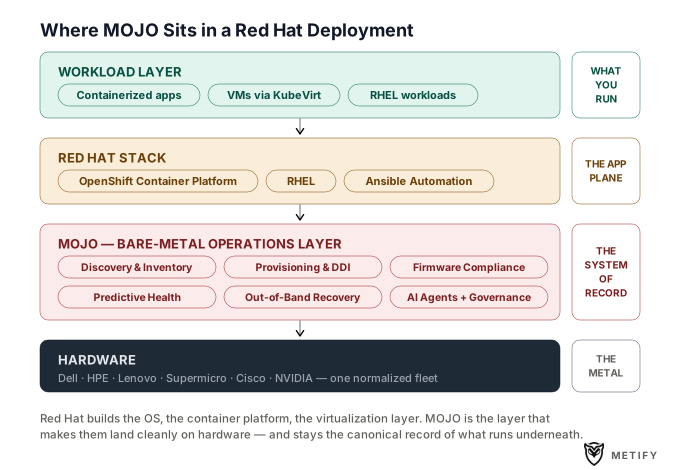 MOJO sits between the silicon and the Red Hat stack. It is the layer that:
- Discovers every BMC in the rack — Dell iDRAC, HPE iLO, Lenovo XCC, Supermicro IPMI — and normalizes them through a single Redfish abstraction.
- Provisions with native DDI (DHCP, DNS, IPAM) so a new node goes from un-racked to RHEL-or-OpenShift-ready without a human touching a spreadsheet or a separate DHCP server.
- Maintains firmware baselines continuously, across vendors, so when a CVE drops you can prove compliance and stage remediation without a spreadsheet-and-prayer ritual.
- Monitors hardware health with a predictive health agent that uses learned baselines and Z-score anomaly detection — flagging an ECC memory degradation trend or a thermal drift before it becomes the cluster outage that takes down your OpenShift control plane.
- Provides out-of-band recovery through integrated KVM and console, so when something goes wrong at 2am at a remote site, you don’t drive there. The orchestrator agent reaches the BMC over Redfish and brings the node back.
This is the operational layer Red Hat’s product line needs but isn’t trying to be. Red Hat builds the OS, the container platform, the virtualization layer, the automation platform. We build the layer that makes those products land cleanly on hardware and stay healthy there.
The Three Engagements Where We Show Up Together
In practice, Metify and Red Hat overlap in three repeatable customer scenarios.
1. OpenShift Rollouts on Bare Metal
When an organization stands up OpenShift on bare metal — particularly the IPI (Installer Provisioned Infrastructure) or Assisted Installer paths — the success of the rollout is gated by the consistency of the underlying hardware. Mixed firmware versions across nodes? Cluster instability. Inconsistent BIOS settings? Performance variance the SRE team will spend months chasing. No way to manage power and boot order remotely? Every recovery is a truck roll.💡 WHAT MOJO ADDS TO AN OPENSHIFT ROLLOUT
A pre-flight firmware baseline check across every node in the planned cluster. Vendor-normalized BIOS settings. Automated PXE handoff to the OpenShift Assisted Installer. Continuous health monitoring after the cluster is up. And when a node needs to be replaced, MOJO’s orchestrator agent decomposes the work — “replace the failed node in production cluster east-2” — into discovery, IPAM allocation, firmware baseline check, OpenShift bootstrapping, and validation. Without the operator typing a single command after the intent.
2. Enterprise-Wide RHEL Deployments
A fleet-scale RHEL deployment looks deceptively simple from the Red Hat side — Image Builder, Satellite, Ansible — but the failure modes are almost always at the hardware boundary. Servers from three different OEMs with three different out-of-band management quirks. Firmware versions that drifted across two acquisition cycles. Inventory that exists in a Google Sheet a former employee maintained. MOJO is the layer that gives Red Hat’s tooling a clean substrate. One inventory across vendors. One firmware compliance model. One out-of-band management interface. One audit trail. The Ansible playbooks Red Hat ships work better when the floor underneath them is consistent — and MOJO is what makes it consistent.
3. Day 2 Ops That Span the Stack
Day 2 is where deployments go to die. Patches need to land. Firmware needs to update. Compliance posture needs to be evidenced for auditors. Hardware fails and needs to be replaced without taking the application down. Capacity needs to expand and the new nodes need to look exactly like the old ones. This is the work that Red Hat’s automation platform and Metify’s AI agents are jointly very good at. Ansible can patch a thousand RHEL hosts. MOJO can verify that the thousand hosts underneath those RHEL installs are on the right firmware baselines, with healthy DIMMs and stable BMCs, before the patches even run. When something doesn’t fit, MOJO’s compliance agent flags it, generates a remediation plan, and routes the plan through governance before any change happens. Day 2 ops is where the Metify + Red Hat story is most concrete and least theoretical. The Red Hat stack runs the applications. MOJO runs the substrate. Together they cover the full lifecycle without forcing a customer to assemble it from parts.
What This Looks Like When It Goes Right
Imagine a regional bank that’s exiting VMware. Their target is OpenShift Virtualization on bare metal, with RHEL hosts running supporting services and Ansible Automation Platform handling the configuration management. Eighteen months ago this would have been three separate procurement conversations and a six-month integration project. Today the engagement looks like this:
| Phase | Red Hat Provides | MOJO Provides |
|---|---|---|
| Discovery & Planning | vSphere assessment via MTV; workload analysis; sizing | Hardware inventory across vendors; firmware audit; readiness report |
| Provisioning | OpenShift Assisted Installer / IPI; RHEL Image Builder | Bare-metal discovery; DDI; PXE handoff; firmware baseline enforcement |
| VM Migration | Migration Toolkit for Virtualization (MTV / Forklift) | Capacity validation on target hosts; predictive health monitoring during cutover |
| Day 2 Operations | Ansible playbooks; OpenShift cluster lifecycle | Predictive health, firmware drift detection, AI-orchestrated remediation |
| Audit & Compliance | OpenShift Compliance Operator; RHEL STIG profiles | Hardware-level compliance evidence; immutable audit trail across all AI agent actions |
Two products. One coherent customer outcome. No integration tax.
The Hidden Benefit for Red Hat Customers: A System of Record
There’s one more benefit that doesn’t show up on the architecture slide but matters more than most customers realize. When a Red Hat shop deploys MOJO underneath its RHEL fleet and OpenShift clusters, it doesn’t just get a hardware operations layer — it gets a system of record for what’s actually running on the physical infrastructure. Across every site. Every vendor. Every firmware revision. Every change. For Red Hat customers in regulated industries, this is the property that closes audit gaps. Across our customer base, MOJO has become the canonical source of truth for the hardware running in:
- Enterprise data centers — multi-OEM RHEL and OpenShift estates where Red Hat Satellite knows the OS layer but the hardware underneath used to live in three vendor consoles
- Retail stores — distributed OpenShift edge clusters at the store level, with MOJO as the unified inventory across hundreds of locations
- Hospitals and clinics — RHEL hosts and OpenShift clusters under HIPAA scope, where auditors need a defensible answer for hardware state at every point in time
- Banks and financial services — OpenShift platforms under PCI DSS and SOX scope, where the gap between “the OS is patched” and “the hardware underneath is on a known firmware baseline” is the gap that auditors actually scrutinize
- Cell-site shelters — telecom edge compute where OpenShift runs latency-sensitive workloads on a few servers at the base of every tower, and the central NOC needs canonical state for every shelter
This is the part of the joint Metify–Red Hat story that doesn’t fit on a one-slide architecture diagram but reliably shows up in the third meeting with the customer’s compliance team. Red Hat’s tooling tracks the OS and the workload. MOJO tracks the physical truth underneath. Together they answer every question an auditor or a regulator can ask, in one export, from one platform.
The Channel-Builder’s Perspective
I’ll close where I started. The reason I built Metify the way I did — and the reason we lead with Red Hat partnership as a first-class story rather than a slide buried in deck six — is that I spent eight years watching what worked in the Red Hat ecosystem and what didn’t. What worked: ISVs whose products genuinely needed Red Hat to exist, and made Red Hat’s products materially better when they were present. What didn’t: ISVs whose pitch was “we work with Red Hat” and whose architecture told a different story when you looked carefully. MOJO needs Red Hat in our customer base. The growing wave of enterprises landing on OpenShift Virtualization need a bare-metal operations layer that’s serious about RHEL, serious about OpenShift, serious about Ansible — and serious about the hardware those products run on. We built one. We’re a Red Hat ISV partner because that’s the most honest description of how our products fit together. If you’re planning a VMware exit and Red Hat is on your shortlist (and based on the customer conversations I’ve had in the last six months, it almost certainly is), let’s talk about what the bare-metal layer underneath looks like. The Red Hat stack will handle your applications, your VMs, your automation. MOJO will handle the substrate. Together they cover the gap that VMware used to fill — and they do it without a per-socket license, without a vendor-controlled operational layer, and without the renewal letter that arrives once a year with a 1,050% number on it.
Metify is a Red Hat ISV partner. MOJO is the AI-native bare-metal infrastructure platform built to be the hardware operations layer for RHEL, OpenShift, and OpenShift Virtualization deployments. To learn more about how MOJO integrates with the Red Hat stack — or to discuss a joint Red Hat + Metify engagement — visit metify.io.Download Free Trial